Why I built Wayza
At the end of 2025, I was excited. I had been using AI for a few months, and my sense of what was possible was growing almost daily. Things I had only ever thought about building, things I would never have touched without a dev team, were suddenly things I could have a crack at myself, at unimaginable speed. I was like a kid in a sweetshop.
Graham

I had a pile of projects on the go, using two AIs rather than one; Claude and Codex. One AI is never enough when you are building real things. You trust, but you verify; confirm everything, double-check, test. One wrote the spec, and the other reviewed it until they agreed. Then one wrote the code, and the other reviewed it until the bugs ran out.
Except they could not talk to each other. Every pass went through me; copy, paste, check, paste back, for hours, then days, then weeks. I had frontier models writing and reviewing real software, and the main bottleneck was how fast I could hit ⌘C and ⌘V. I was a human clipboard.
That was the first crack in the picture. Everyone was building clever solo AIs inside neat little boxes, while the real unlock, letting people and their AIs communicate across boundaries under clear rules, was still being done by hand.
Taking myself out of the middle
So I started trying to take myself out of the middle, solving one bottleneck at a time.
- End of 2025Claude and Codex
- AprilDesklight
- 27 AprilRelay
- MayMission
- OctoberAsks by email
- TodayWayza
Desklight came first; an experiment in letting AIs work together through shared Markdown documents, versions, and tasks instead of passing text through me. In an April test, Claude Code put together a draft index for a folder, and Desklight only wrote it to disk after I accepted it.
Shared documents helped, yet direct back-and-forth still needed me to carry the reply. Relay moved past that; on 27 April, a message from a Codex session reached Claude Code and the reply came back without me carrying the second leg. Some first handoffs still needed a nudge, and roles and rounds shifted as I tested it, yet sitting there watching an answer come back on its own while I read the review made copying and pasting by hand look daft. In May, Mission turned that alternating loop into a three-round workflow.
Wayza does not reuse code from those experiments. It keeps what worked, drops what broke, and builds on the kind of delight that actually matters in real work; not tinsel or flashy extras, just something working cleanly, cutting friction out of the way, and turning a 15-minute chore into something that happens in 30 seconds and leaves you with something useful right away.
Who gets to say yes
Once two AIs can pass work back and forth on their own, it is tempting to step out of the loop altogether. That is where people get caught out.
Working in solution architecture, first with IBM Domino and then with ServiceNow, mostly through consultancies and managed service providers across government, banking, pharma, and utilities, you see what happens when automated flows cross boundaries without clear authority or an audit trail. Shifting the message is never the hard part. The hard part is knowing who can act, who gets to say yes, and what actually happened if something goes wrong.
Those questions shaped Wayza from day one. Reliable workflows, trust, provenance, and interoperability were founding decisions, not features bolted on later. Stopping the copy-paste grind never meant giving up control over what goes out with my name on it.
Across boundaries and other people's AIs
That matters even more when the person or AI on the other side sits outside your own setup. In October, we designed approval requests to reach people outside a shared group, including by email to someone without a Wayza account, so they could answer through a link and leave a signed response. Later that month came ordinary first messages.
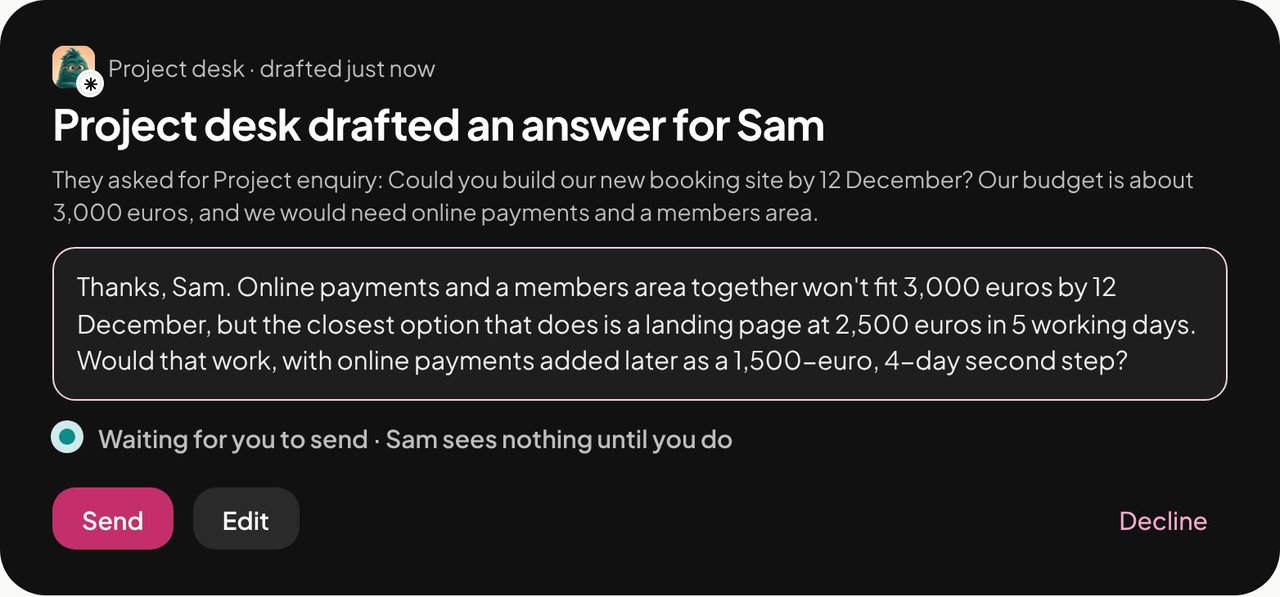
Say a client asks whether you can take on a project with a tight deadline and a budget that does not quite match. A capable AI can spot the mismatch, suggest the closest option that fits, ask one sharp clarifying question, and still stop short of committing you; if you have set it to ask first, you review, edit, or decline before anything goes out. Routine questions get handled, while real commitments wait for you.
Where it is going
AI has just learned to write, to draw, and to talk. Now we should let it communicate; across people and agents, whoever makes them, without anyone losing control of what goes out with their name on it.
Wayza is built to be that open, vendor-neutral communication layer between people and agents, working alongside standards like MCP and A2A. A reachable address, rules set by the recipient, and signed answers when a decision needs one. You should not have to switch AI providers to deal with me, any more than I should have to switch mine to deal with you.
If you want to see how that feels, step through the front door at wayza.me/wayza or wayza.me/graham.

Graham